
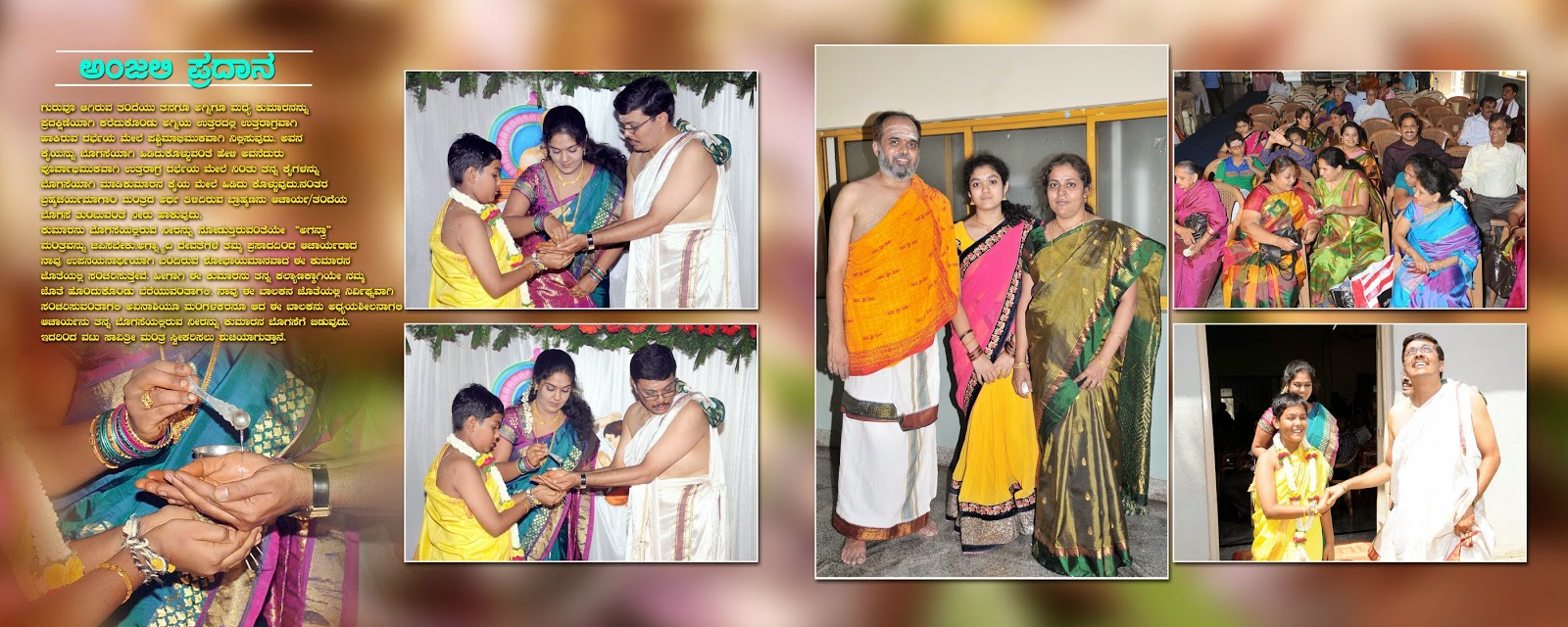
BRAMHOPADESHAM- SHREYAS 09TH APRIL 2015
Upanayana (IAST: Upanayanam, Sanskrit: उपनयन) is one of the traditional Saṃskāra (rites of passage), that marked the acceptance of a student by a Guru (teacher) and an individual's entrance to a school in Hinduism. The tradition is widely discussed in ancient Sanskrit texts of India, and varies regionally.
The Upanayana was restricted, in many medieval Indian texts to upper three of four varnas (caste, class) of society, including Brahmin, Kshtriya and Vaishya. However, older Vedic era texts such as the Baudhayana Gryha Sutra encouraged all members of society to undertake Upanayana rite of passage, including the Sudra.Women were encouraged to undergo Upanayana rite of passage in ancient India, either before they started Vedic studies or before their wedding


Upanayana (उपनयन) literally means "the act of leading to or near". It is an important and widely discussed samskara in ancient Sanskrit text. The rite of passage symbolizes the leading or drawing towards the self of a child, in a school, by a teacher. It is a ceremony in which a Guru (teacher) accepts and draws a boy towards knowledge and initiates the second birth that is of the young mind and spirit.
Description
A boy during his upanayana ritual. The thin, yellowed, Yajnopavita thread runs from left shoulder to waist. Note the munja grass girdle around the waist. The peepal tree twig in his right hand marks his entry into the Brahmacharya stage of life.
Upanayana the ancient Indian rite of passage for the start of formal education of writing, numbers, reading, Vedangas, arts and other skills. The Upanayana rite of passage was also important to the teacher, as the student would therefrom begin to live in the Gurukul (school).
Upanayana was an elaborate ceremony, that included rituals involving the family, the child and the teacher. A boy receives during this ceremony a sacred thread called Yajñopaveetam, that he wears. Yajñopavita ceremony announced that the child had entered into formal education. In the modern era, the Upanayana rite of passage is open to anyone at any age.
The education of a student was not limited to ritual and philosophical speculations found in the Vedas and the Upanishads. They extended to many arts and crafts, which had their own but similar rites of passages. Aitareya Brahmana, Agamas and Puranas literature of Hinduism describe these as Shilpa Sastras, and they extend to all practical aspects of culture, such as the sculptor, the potter, the perfumer, the wheelwright, the painter, the weaver, the architect, the dancer, and the musician. Ancient Indian texts assert that the number of the arts is unlimited, but each deploy elements of sixty four ‘‘kala’’ (कला, techniques) and thirty two ‘‘vidyas’’ (विद्या, fields of knowledge).The training of these began from childhood, and included studies about dharma, culture, reading, writing, mathematics, geometry, colors, tools, as well as traditions (trade secrets). The rites of passage during apprentice education varied in the respective guilds.
Rajbali Pandey compares the Upanayana rite of passage to Baptism in Christianity where the person is born again unto spiritual knowledge, as the ceremony marketed the initiation of the student for spiritual studies such as the Vedas.
Age, gender and varna restrictions
In Hindu traditions, a human being is born at least twice – one at physical birth through mother's womb, and second at intellectual birth through teacher's care, the first is marked through Jatakarman sanskara ritual, the second is marked through Upanayanam or Vidyarambha rites of passage. A sacred thread was given by the teacher during the initiation to school ceremony, and was a symbolic reminder to the student of his purpose at school as well as a social marker of the student as someone who has been born a second time (dvi-ja, twice born) he went about collecting fire wood in forest and food donations from villages on a daily basis.
Many medieval era texts discuss Upanayana in the context of three Varnas (caste, class) - Brahmins, Kshtreyas and Vaishyas.[8] Several texts such as Sushruta Sutrasthana, however, also include Sudras entering schools and the formal education process,Stating that the Upanayana samskara was open to everyone.The Baudhayana Gryha Sutra in verses 2.5.8 and 2.5.9 states the teacher to,
Let him initiate [to school through Upanayana] a Brahmin in spring, a Kshatriya in summer, a Vaishya in autumn, a Sudra in the rainy season; or all of them in the spring.
—Baudhayana Gryha Sutra
The ceremony was typically performed at age eight among the Brahmins, at age 11 among the Kshatriyas, and age 12 among Vaishyas. Apastamba Gryha Sutra, in verse 1.1.1.27, places a maximum age limit of 24 for the Upanayana ceremony and start of formal education. However, Gautama Gryha Sutra and other ancient texts state that there is no age restriction and anyone of any age can undertake Upanayanam when they feel they initiate their formal studies of the Vedas.
Women and Upanayana
In some regions, in the modern times, both boys and girls undergo the tradition of Upanayana initiation when they start their formal schooling. In ancient and medieval era, texts such as Harita Dharmasutras, Asvalayana Grhya Sutra and Yama smriti suggest women could begin Vedic studies after the Upanayana rite of passage.
Girls who decided to become a student underwent the Upanayana rite of passage, at the age of 8, and thereafter called Brahmavadini. They wore a thread or upper garment over their left shoulder.Those girls who chose not to go to a Gurukul were called Sadyovadhu (literally, one who marries straight). However, the Sadyovadhu too underwent a step during the wedding rituals, where she would complete Upanayana, and thereafter wear her upper garment (Saree) over her left shoulder. This interim symbolic Upanayana rite of passage for a girl, prior to her wedding, is described in multiple texts such as the Gobhila Gryha Sutra verse 2.1.19 and various Dharmasutras.
.jpg)




Significance of the yajñopavītam, sacred thread
The "sacred thread" (Sanskrit: यज्ञोपवीतम् yajñopavītam or upavīta) is a thin cord, composed of three cotton strands. The three strands symbolize different things in various regions. For example, among Tamil Hindus, each strand is for each of the three trinity of goddesses (Parvati, Lakshmi and Saraswati)
The ancient Sanskrit texts offer a diverse view while describing yajñopavītam or upavita. The term upavita was originally meant to be any upper garment, as stated in verse 2.2.4.22 - 2.2.4.23 of Apastamba Dharmasutra, or if the wearer doesn't want to wear a top, then just a thread would suffice. The thread identified a person who is studying at a school or has graduated. The ancient Indian scholar Haradatta states, "yajñopavītam means a particular mode of wearing the upper garment, and it is not necessary to have the yajñopavīta at all times". The Gobhila Gryha Sutra similarly states, at verse 1.2.1 in its discussion on Upanayana, that "the student understands the yajnopavita as a cord of threads, or a garment, or a rope of kusa grass", and it is its methods of wearing and the significance that matters. The proper manner of wearing the upper garment or thread, state the ancient texts, is from over the left shoulder and under the right arm.
The idea of wearing method of the upper garment or sacred thread, and its significance, extended to women. This is reflected in the traditional wearing of Sari over her left shoulder, during formal occasions and the celebration of rites of passage such as Hindu weddings. It was also the norm if a girl undertakes the Upanayana ceremony and begins her Vedic studies as a Brahmavadini.
The sacred Yajñopavītam is known by many names (varying by region and community), such as Bratabandha, Janivaara, Jandhyam, Poita, Pūṇūl, Janeu, Lagun, Yajnopavita, Yagyopavit, Yonya and Zunnar. The other Sanskrit term for it is Avyanga.
[text source: wikipedia]
[text source: wikipedia]


